11+ punctuation
Full stops, commas, apostrophes, speech marks and more. Learn each rule with Punctuation Quest, then practise with untimed and timed 11+ exam-style quizzes.
Works on any device. Or create a free account for free quizzes.
Learn with Punctuation Quest
Practice tool · progress saved on this device onlyLearn the rules and practise as much as you like. When you’re ready, take the tests below: their scores are saved to your TestLife account so you can track progress.
Punctuation Quest
Small steps. Sharp eyes. Brilliant writing.
Every mark has a job.
Let’s learn what it does.
Start with the green examples, build up to blue, then try the purple 11+ challenges. Read each sentence aloud: punctuation helps your voice know what to do.
Today’s mission
Answer 10 questions to fill the bar.
Punctuation toolkit
Choose a mark. There are lots of examples, from easy to exam-ready.
Example ladder
Smart Practice
Choose your focus from a bank of 70 questions. Questions become more challenging as you improve.
TestLife Sentence Challenge
Each attempt draws 10 questions from a bank of 70. Read the sentence naturally, select the part containing the mistake, or choose No error.
My punctuation power
Answer some questions to begin.
Skill mastery
Every answer updates these bars. Aim for 80% or higher.
Untimed test
Untimed · score saved10 questions, no time limit. Take your time and learn from each answer.
Report a question
Please login first to access this quiz.
Timed test
Timed · score savedPractise under exam conditions once the rules feel secure.
Year 4 test
Untimed · Year 4 · score savedA gentler test for younger children.
Report a question
Please login first to access this quiz.
Punctuation rules for the 11+
Punctuation makes writing clear. In the 11+ exam, punctuation questions check that your child can spot and use each mark correctly.
The key punctuation marks
- .Full stopends a statement. I enjoy reading books.
- ,Commaseparates items in a list or adds a pause. I bought apples, oranges and bananas.
- ’Apostropheshows missing letters or belonging. I can’t play today. That is Sarah’s bag.
- ?Question markends a question. What time does the lesson start?
- !Exclamation markshows strong feeling; use it sparingly. Watch out!
- “ ”Speech marksshow the exact words someone says. “I am ready,” said Tom.
Exam tips
- Read each sentence carefully before choosing punctuation.
- For apostrophes, ask: does something belong to someone, or are letters missing?
- Don’t overuse commas or exclamation marks.
- Always re-read your answers to spot missing punctuation.
Correct punctuation shows the examiner you understand how sentences work, and even a small mistake can change a sentence’s meaning. Regular practice helps your child avoid common errors and improves their writing marks.
Full punctuation rules, with chart
The image below has some of the important punctuation rules explained.
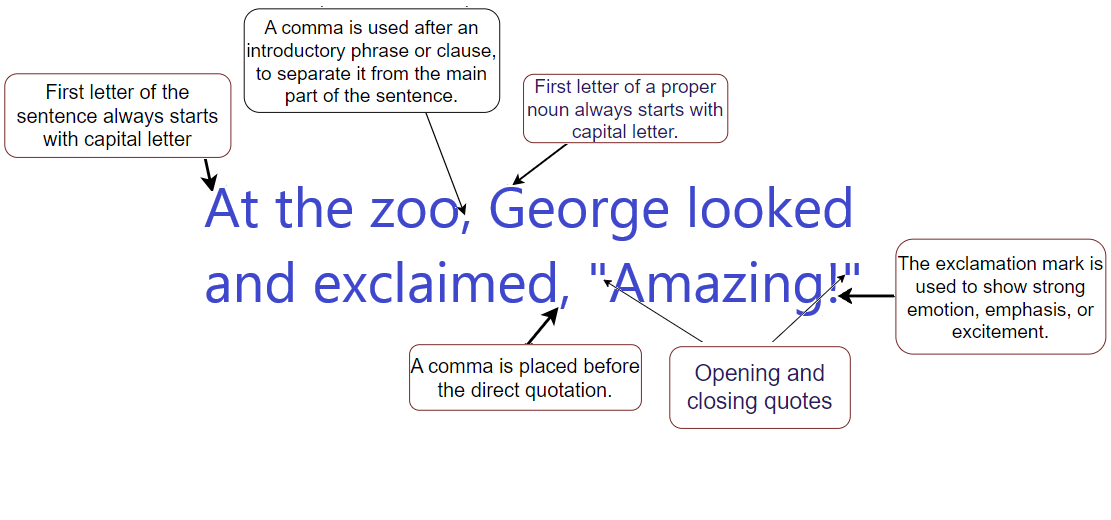
The most important rules of punctuation are:
Capital Letters:
- The first word of a sentence and proper nouns must begin with a capital letter.
- Example: “George went to the zoo.”
Commas:
- After introductory elements: Use a comma after introductory words or phrases.
- Example: “At the zoo, George saw a lion.”
- In lists: Separate items in a list with commas.
- Example: “She bought apples, oranges, and bananas.”
- Before quotes: A comma is used before a direct quotation.
- Example: George said, “It’s amazing!”
- Inside quotes: The comma goes inside closing quotation marks when introducing dialogue.
- Example: “It’s sunny,” she said.
- Before conjunctions: Use a comma before coordinating conjunctions (and, but, or) in compound sentences.
- Example: “She studied hard, and she passed the test.”
Quotation Marks:
- Use quotation marks to enclose direct speech or quotes.
- Example: She said, “Let’s go!”
- Punctuation inside quotes: Periods and commas go inside quotation marks.
- Example: “It was wonderful,” he said.
- Exclamation and question marks: These go inside the quotes if part of the quoted text.
- Example: “Are you coming?” she asked.
4. Periods
- Use a period to mark the end of a declarative sentence.
- Example: “He finished his homework.”
5. Exclamation Marks
- Use exclamation marks to show strong emotion or emphasis.
- Example: “Wow, that was amazing!”
6. Question Marks
- Use question marks at the end of a direct question.
- Example: “Where are we going?”
7. Apostrophes
- Contractions: Use apostrophes to show omitted letters.
- Example: “Do not” becomes “Don’t.”
- Possession: Use apostrophes to show ownership.
- Example: “George’s book is new.”
8. Colons
- Use a colon to introduce a list, quotation, or explanation.
- Example: “She needs the following: paper, pens, and markers.”
9. Semicolons
- Use semicolons to link closely related independent clauses without a conjunction.
- Example: “He loves to read; she prefers movies.”
10. Dashes
- Use dashes for emphasis or to set off an idea.
- Example: “She gave her best effort – even though she was tired.”
Get full access to every English topic
Start your 7-day free trial — full refund within 14 days of payment.