
11+ Area and Perimeter practice


11+ Area and Perimeter practice ( Year 4) - Untimed
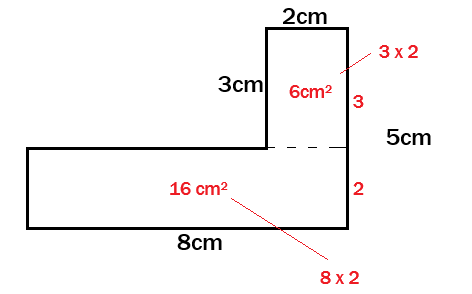
Area = 16 + 6 = 22 cm²
Perimeter = 8 + 8 + 3 + 5 = 24 cm
11+ Area and Perimeter practice | Success Guide
Area and perimeter are core skills in 11+ Area and Perimeter practice, and they appear frequently in GL and CEM Maths papers. Students must understand how to calculate both the perimeter (the total distance around a shape) and the area (the amount of space inside the shape). Strengthening these skills through regular 11+ Area and Perimeter practice helps children improve accuracy, confidence and exam-style reasoning.
Perimeter involves adding all the side lengths.
Example:
A rectangle measuring 8 cm by 5 cm has a perimeter of:
8 + 8 + 5 + 5 = 26 cm.
This type of question is common in 11+ Area and Perimeter practice, especially when one side is missing.
Area requires multiplying for rectangles and squares:
Area = length × width
Example:
An 8 cm by 5 cm rectangle has an area of:
8 × 5 = 40 cm².
In 11+ exams, students often see questions involving compound shapes, missing lengths, and word problems. A good strategy is to label diagrams clearly, convert units carefully, and remember:
Add sides → perimeter
Multiply dimensions → area
Another useful shortcut for compound shapes is to split the shape into rectangles and find the area of each part. This method reduces mistakes and is widely used in 11+ Area and Perimeter practice.
For additional revision and topic support, students can review measurement topics on BBC Bitesize:
👉 Area and Volume
Regular 11+ Area and Perimeter practice, using worksheets and quizzes, ensures children develop the speed and confidence needed for exam success.

